

Latest News

Read more news
-
 PathWest (Forensic Biology) and ChemCentre win the 2025 WA Government Innovator of the Year Award 18 November 2025 We congratulate our PathWest (Forensic Biology) team, who jointly with ChemCentre, have been named the 2025 Western Australian Government Innovator of the Year. The Award, announced recently by Science and Medical Research Minister Stephen Dawson at the 19th annual Western Australian Innovators of the Year Awards, recognises world-first research by ChemCentre and the PathWest (Forensic Biology) Research & Development team led by Dr Marie Rye. This ground-breaking work centres on using the proteins in hair for human forensic identification. While DNA analysis remains the gold standard for identifying individuals, evidence such as hair shafts often contain insufficient DNA for analysis. A single human hair comprises a combination of protein variants which can be used to infer DNA sequence information. As part of the research project, data will be generated to identify genetic variants...
 -
 PathWest BakeWest - Entries for Overall Winner 04 August 2025 Please note: Voting closed on Thursday 7 August 2025. Overall Winner Cake Entries Genes and germs by Avril Strutt (People, Capability and Culture) Named ‘Genes and Germs’, this colourful retro-inspired cake was created as a school holiday activity with Avril and her children – a celebration of both creativity and science. The name playfully reflects both the cake and the creators. - The ‘P’ cake by Ingrid Iaschi (Environmental Microbiology Unit) To celebrate 20 years of PathWest, the Environmental Microbiology Unit created a striking red chocolate cake in the shape of a bold letter ‘P’. It’s a strong symbol of PathWest’s identity, commitment to public health, and its mission to protect community wellbeing. - Point-of-Care Testing by Elizabeth Byrnes (Biochemistry) Representing the important work of the Point-of-Care Testing te...
 -
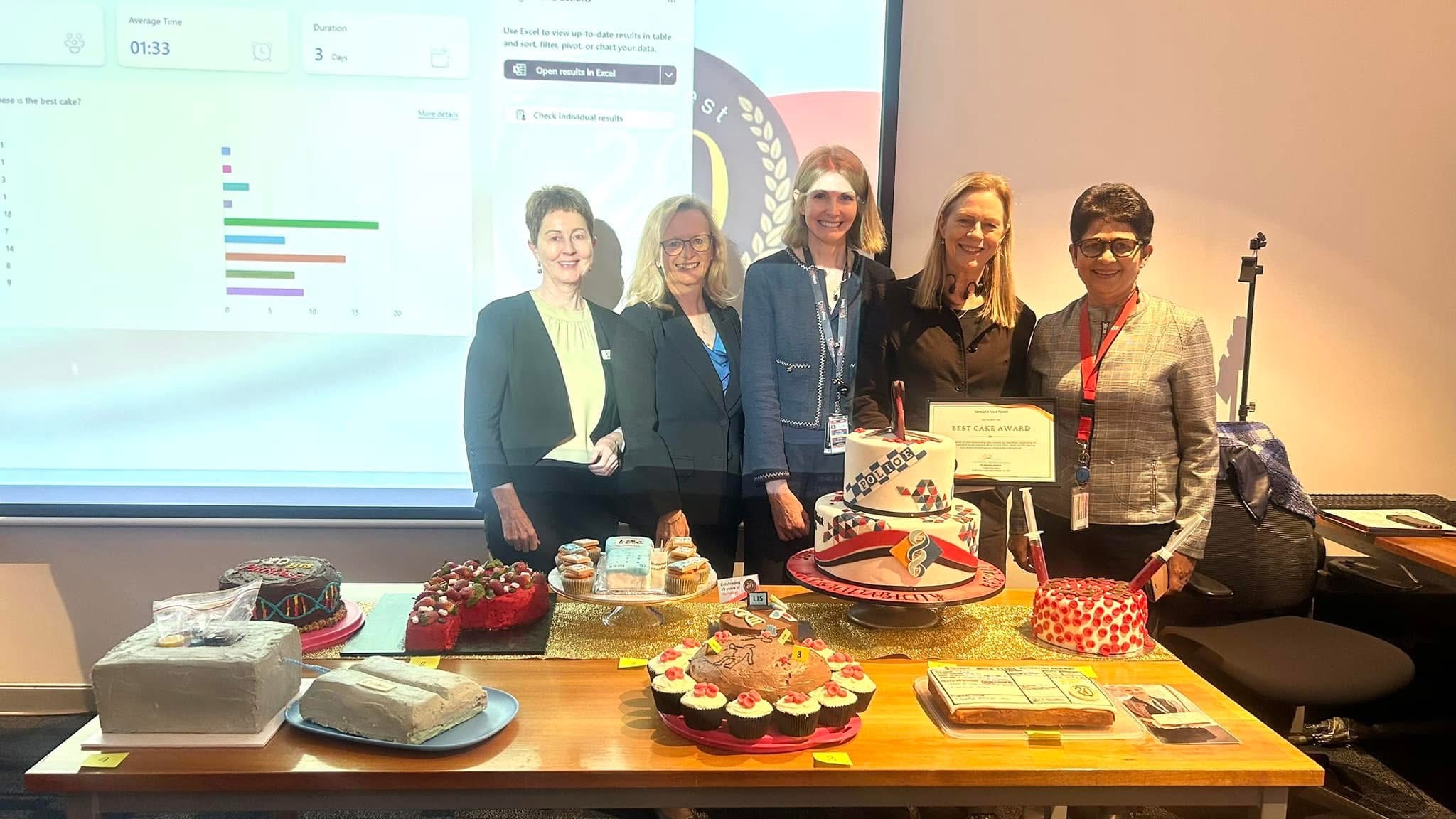 Celebrating 20 years of PathWest 01 August 2025 Last month, we marked two decades of PathWest with special morning teas and site displays at our Queen Elizabeth II (QEII) and Fiona Stanley Hospital (FSH) sites. The morning tea at QEII was attended by the Department of Health Director General, Dr Shirley Bowen, our Chief Executive Dr Narelle Hadlow, Board Chair Angie Paskevicius, and staff from across PathWest. As part of the celebrations, we looked back at key milestones from our 20-year journey. We also held PathWest’s BakeWest cake competition, with live voting at the morning teas. PathWest BakeWest winners Best Cake at QEII Kay Stone, Forensic Pathology The winning cake beautifully represented our evolution from the PathCentre to PathWest – honouring our past and celebrating our future. Best Cake at FSH Abi Hague, FSH Specimen Collection The winning cake featured the message ‘PathWest starts with phlebotomy&...
 -
 Discontinuation of Genetic Testing for Chronic Idiopathic Pancreatitis 30 May 2025 Following a recent review, PathWest will discontinue genetic testing for chronic idiopathic pancreatitis (CIP) from 03 June 2025. This decision follows a clinical and operational review which identified: CIP testing is not supported by Medicare. Current CIP testing has limited clinical utility in comparison to the international benchmark: Low diagnostic yield of less than 10% compared to 20 to 30% (PMID: 39172977). Broader and more comprehensive hereditary pancreatitis testing is available internationally through other providers. These include: Canterbury Health Laboratories (NZ) – PRSS1, SPINK1, CFTR, CELA3B ARUP Laboratories (USA) – CFTR, CTRC, PRSS1, SPINK1 Prevention Genetics (USA) – CASR, CFTR, CPA1, CTRC, PRSS1, SPINK1, TRPV6 Blueprint Genetics (USA) – APOA5, APOC2, CFTR, CPA1, CTRC, GPIHBP1, PRSS1, SPINK1, UBR1 We ap...
 -
 PathWest makes Australia’s top companies’ list for the midsize category 17 April 2025 PathWest is honoured to be named on LinkedIn’s 2025 Top Companies list in Australia for the midsize category – a prestigious recognition celebrating leading workplaces with fewer than 5,000 employees where professionals can thrive and grow their careers. PathWest is the only Western Australian entity to be named for 2025. "This recognition reflects our ongoing commitment to fostering a positive, inclusive, and empowering workplace where every team member feels supported and inspired to reach their full potential", said Dr Narelle Hadlow, PathWest Chief Executive. "Thank you to our incredible team for improving the health, wellbeing, and safety of our communities every day – this achievement is yours." Learn more
Last Updated:
20/05/2025